 English


 Español
You rolled out an AI voice agent last quarter. The demos were flawless. The first week looked promising. But now? Conversion has plateaued, and you keep hearing the same vague feedback from your team: “it sounds robotic,” “customers hang up halfway through,” “something’s off.”
Ask where, exactly, and nobody can tell you.
You’re not alone. This is the single most common reason companies abandon AI voice agents. Not because the technology doesn’t work, but because they can’t see what it’s doing on the calls that matter. You’re spending on minutes, on leads, on infrastructure, and the only feedback loop you have is a gut feeling and a handful of recordings someone happened to listen to.
Signs your AI voice agent needs evaluation (not a new model)
Before you rip out your current voice provider or rewrite your prompt from scratch, check whether you’re actually seeing any of these:
- Conversion is inconsistent between calls that look nearly identical on paper
- Your team can describe problems in feelings (“it’s awkward,” “it rambles”) but not in steps
- You’ve made prompt changes and can’t tell if they helped
- Your CRM has mysterious gaps where data should have synced
- Compliance or legal has started asking what exactly the agent says on every call
If two or more of these sound familiar, your bottleneck isn’t the model. It’s observability.
The real reason AI voice agents fail (and it’s usually not the model)
Most teams assume that when a voice agent underperforms, the fix lives in the model: a better voice, a smarter LLM, a newer provider. In practice, the failure is almost always somewhere else. A specific question that confuses callers. A broken handoff to your CRM. A logic branch that loops. An intent the agent doesn’t recognize.
These failures cluster. One bad block in your conversation flow can be responsible for 15% of your drop-offs. But you’ll never find it by listening to a random sample of ten calls, because random samples surface random problems, not the concentrated ones that are actually costing you money.
Why manual call QA stops working past 100 calls a day
Here’s the math most ops teams try to avoid running:
- 10,000 calls per month
- Review even 5% = 500 calls
- Average 4 minutes per review = 33+ hours of listening, every month
- And you still have to take notes, find patterns, and translate them into prompt changes
So what happens? Teams default to 1% sampling. Or 0.1%. Or they give up on QA entirely. Which means 99% of your agent’s actual behavior is invisible, including the 15% that’s killing your funnel.
From random spot-checks to 100% automated call evaluation
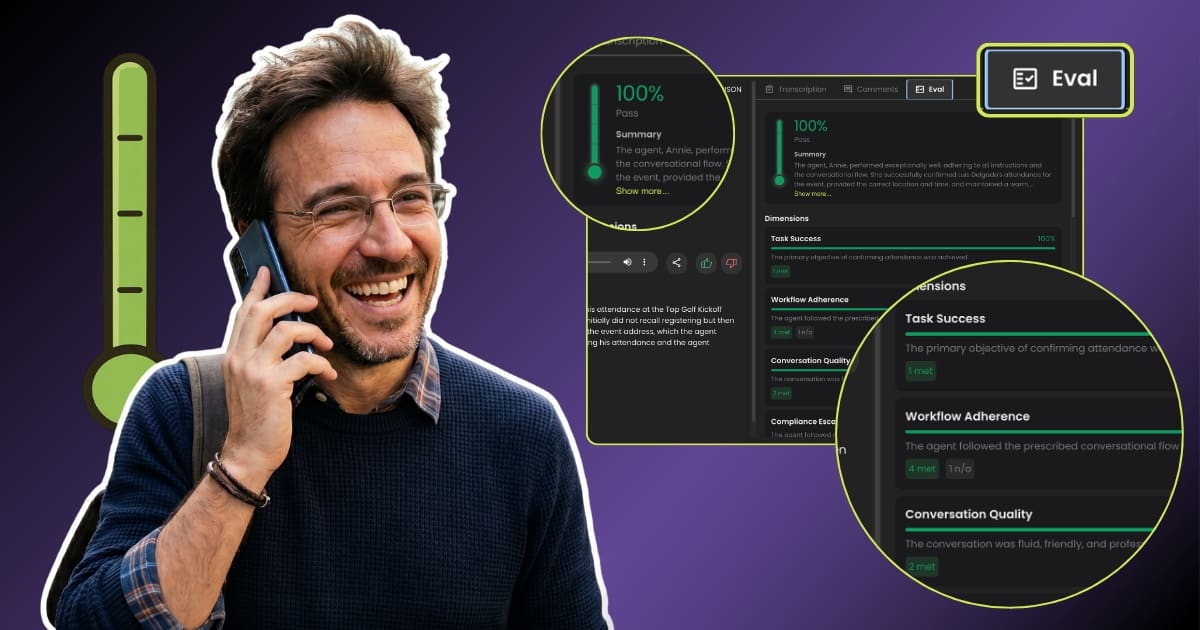
This is the problem we built Call Eval AI to solve. Instead of sampling, it audits every second of every call against the Conversation Flow you designed, and returns two things:
- A weighted Accuracy Score. How closely the agent actually followed the script, weighted by which steps matter most for conversion.
- A JSON of findings. The specific blocks where logic failed, intents were missed, or data didn’t sync.
You stop guessing which step is leaking. You see it.
How to read your Accuracy Score
The Accuracy Score isn’t a vanity metric. It’s designed to be diagnostic. A call that scores 92% isn’t just “good.” It’s telling you that 8% of the weighted logic didn’t execute as designed, and the findings JSON tells you which blocks. Over time, the score becomes a leading indicator: when it dips, you know something drifted before it shows up in your conversion numbers. When a prompt change lifts the average score across a cohort of calls, you have evidence that the change worked, not a hunch.
What this actually solves for voice operations teams
1. “I don’t know which step in my script is leaking conversions.”
Call Eval AI maps every word of every call back to the specific logic block it came from. If 15% of users drop off at Step 3, you see it, and you see why. Fix the prompt, deploy, watch the recovery.
2. “Our improvement cycles take weeks.”
Traditional voice ops suffer from massive latency between spotting a problem and shipping a fix. When the engine flags a failure, it surfaces the exact diagnostic needed to adjust the prompt. The iteration loop shrinks from weeks to minutes.
3. “One hallucination could hurt the brand.”
Manual QA at 1% coverage means 99% of your agent’s behavior runs unsupervised. Call Eval AI flags errors, CRM failures, and logic deviations across 100% of calls, so you catch the one call where the agent promised something it shouldn’t have, before it becomes a reputation issue.
Who should use automated call evaluation
This is built for teams running voice AI at volume, where the cost of not knowing is highest:
- Outbound sales and lead qualification, where every drop-off is a lost pipeline dollar
- Customer service operations, where consistency across thousands of calls is the whole product
- Appointment setting and booking flows, where a single broken step kills the conversion
- Collections and compliance-heavy calls, where one wrong phrase is a regulatory risk
Frequently asked questions
How is Call Eval AI different from call transcription or sentiment analysis?
Transcription tells you what was said. Sentiment tells you how it felt. Call Eval AI tells you how the agent performed against your business logic: which step it was on, whether it followed the flow, whether it synced data, whether it hit the intent. It’s QA, not just listening.
Do I need to change my existing conversation flows?
No. Call Eval AI reads your existing flow as the source of truth and evaluates calls against it. If you change the flow, evaluation adapts automatically.
How quickly can I see results?
Most teams run their first automated audit within minutes of connecting. The first high-impact finding, the “we didn’t know that was happening” moment, usually lands on day one.
Does this replace human review entirely?
It replaces the grunt work of listening to thousands of recordings to find patterns. Humans stay in the loop for the decisions that matter: what to prioritize, how to rewrite the prompt, which edge cases to protect.
What should I do with the findings once I have them?
Start with the highest-frequency failure at your most conversion-critical step. One fix there tends to return more than ten fixes scattered across low-impact blocks. Prioritize ruthlessly. The point of 100% coverage isn’t to act on everything. It’s to make sure you’re acting on the right thing.
Can I use Call Eval AI to evaluate voice agents built outside Dapta?
Today, Call Eval AI runs against flows built in Dapta’s Agents Studio, so the evaluation can reference the exact logic blocks in your conversation. Teams migrating from other platforms typically rebuild their flow once, then get continuous evaluation from that point forward.
Stop guessing. Start seeing.
If your AI voice agent is “working” but you can’t explain why conversion is where it is, you’re operating on vibes. Call Eval AI replaces vibes with data: a specific block, a specific failure, a specific fix. The teams pulling ahead in voice AI aren’t the ones with the best model. They’re the ones with the tightest feedback loop between what happens on a call and what changes in the flow.


