



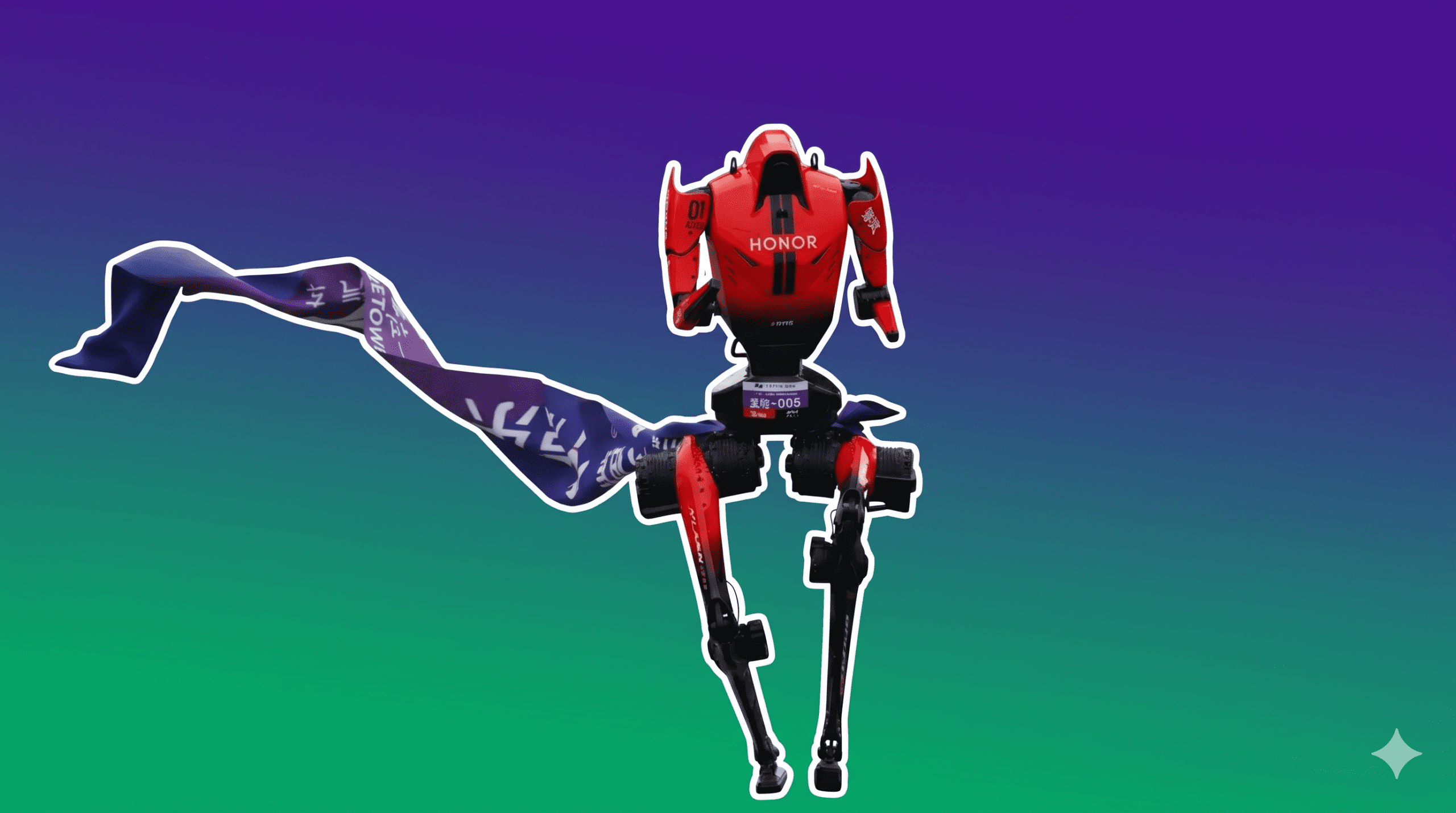
On April 19, 2026, a bright-red humanoid robot named Lightning crossed the finish line of the Beijing E-Town Half Marathon in 50 minutes and 26 seconds, beating the human world record for the same distance by nearly seven minutes. The winning robot, built by Chinese smartphone maker Honor, stands 169 centimeters tall. For context, Uganda’s Jacob Kiplimo holds the human half-marathon world record at approximately 57 minutes, set in Lisbon earlier in 2026. A machine just covered 21 kilometers faster than any human in history, and the gap was not close.
The race itself was remarkable for more than just the winning time. More than 100 humanoid robots competed in the event alongside 12,000 human runners, making it the largest robot-versus-human race ever staged. The Beijing E-Town Half Marathon took place in an industrial park area on the outskirts of Beijing, chosen partly because the controlled environment suits the current capabilities of walking and running robots. Lightning’s performance was not without drama: the robot crashed into a railing near the end of the race, received help standing back up, and recovered to complete the dramatic finish that sealed the victory.
The year-over-year improvement in humanoid robot performance is the more important data point. In 2025, the winning robot at the same event took 2 hours and 40 minutes to complete the half-marathon distance, and only 6 of 21 robots finished at all. In 2026, the winning time dropped to 50 minutes, and a substantially larger field of over 100 robots competed. That represents more than a 3x improvement in winning pace in a single year, which is the kind of progression curve that typically precedes commercial deployment of a technology.
The financial context matters. The Chinese government recently committed approximately $138 billion to a state fund dedicated to humanoid robot development. That is not a pilot program. It is industrial-scale investment aimed at establishing China as the leader in humanoid robotics for logistics, manufacturing, eldercare, and domestic labor. Honor, primarily known for smartphones, entering the humanoid robotics race is a signal that Chinese consumer electronics companies view humanoids as the next hardware platform after phones and electric vehicles.
What Lightning’s performance actually demonstrates is not running speed in any commercially relevant sense. Nobody needs a robot that can run a half-marathon. What the race demonstrates is control, balance, endurance, battery efficiency, and the ability to recover from physical interference (the railing incident), all over 21 kilometers of sustained locomotion. These are exactly the capabilities that translate into warehouse robots that don’t fall over, eldercare robots that can walk alongside a patient, and factory robots that can handle unplanned obstacles. The marathon is a stress test, not a use case.

For the broader humanoid robot industry, Beijing E-Town is a reference point. Tesla’s Optimus, Figure’s humanoids, Boston Dynamics’ Atlas, and a growing roster of Chinese competitors including Unitree and now Honor are all racing toward the same endpoint: general-purpose humanoid robots that can operate in human environments without custom infrastructure. The fact that a Chinese smartphone maker put a robot on the course that outpaced a human world record holder by seven minutes indicates that the engineering capabilities are no longer concentrated in a small number of specialist firms.
For Latin America and emerging markets, the implications are mixed. Humanoid robots built in China at scale will likely reach global markets at price points that transform logistics, manufacturing, and eventually service industries. Countries that depend on labor-intensive export sectors face a reshuffling of comparative advantage as automation shifts from robotic arms in factories to humanoid robots that can perform tasks previously requiring human flexibility. At the same time, the same robots will be available for purchase in LATAM markets, creating opportunities for companies willing to invest in automation early.
The symbolism of Lightning’s victory shouldn’t overshadow the technical reality: we are still years away from humanoid robots being economically viable for most tasks. Running is easier than folding laundry. But the fact that a production robot from a consumer electronics company can outrun the world’s fastest human over 21 kilometers, on a public course, in front of a crowd, is a milestone that even the most skeptical observers of humanoid robotics will have to recalibrate around. The race in 2027 will be worth watching.


