

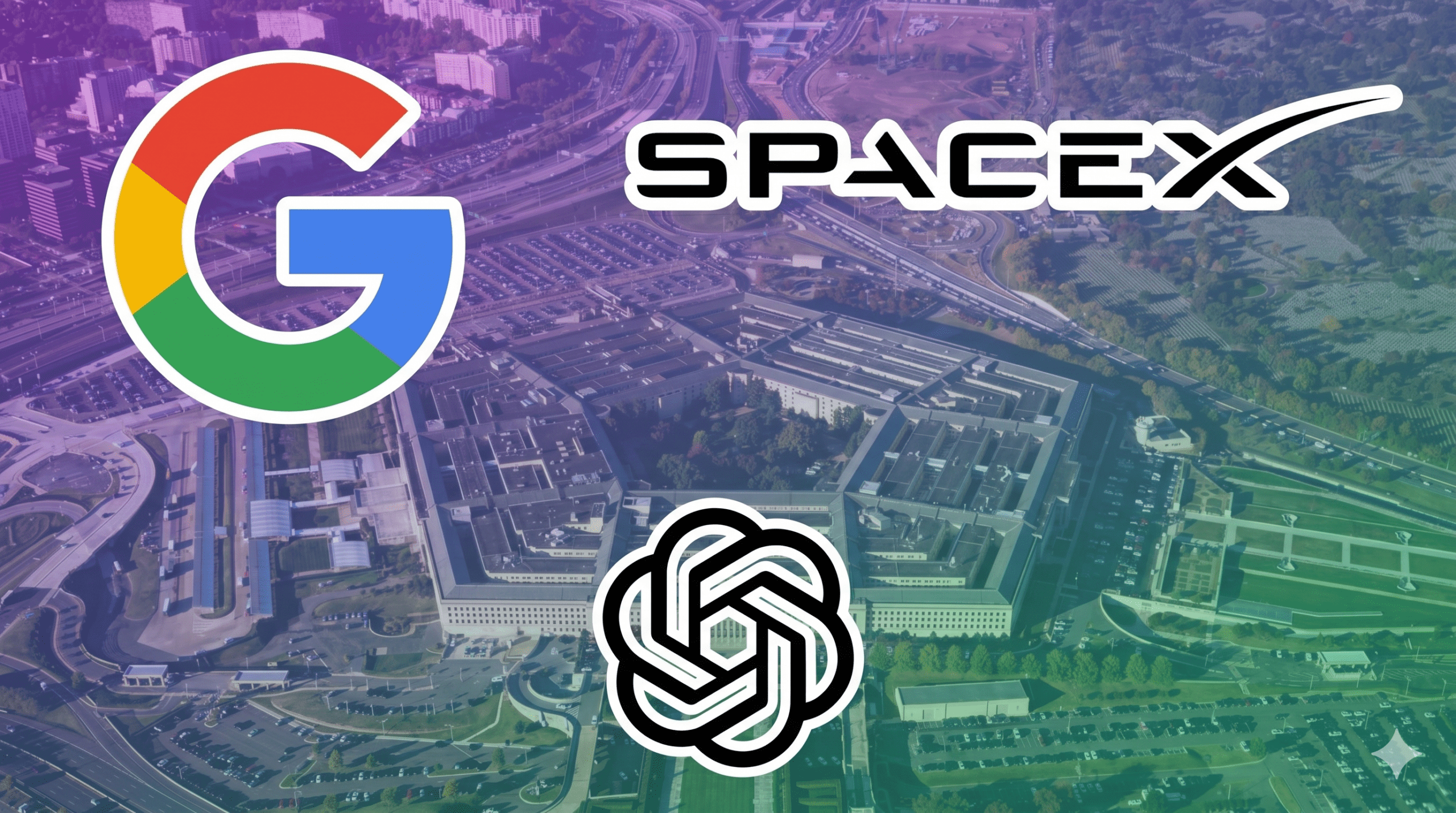
The Pentagon has signed formal artificial intelligence contracts with SpaceX, Google, and OpenAI, deliberately leaving Anthropic out of the initial vendor pool and triggering internal protests among Google employees opposed to military applications of their work. The decision marks the most explicit alignment between US government AI procurement and the commercial AI vendors that have dominated 2025 and 2026, with implications for which models will power national security workflows and which companies will see their valuations supported by stable defense revenue.
The exclusion of Anthropic is the headline. Anthropic has spent the past two years building a public position around AI safety, alignment research, and constitutional model design, branding itself as the frontier-model vendor most concerned about the risks of advanced AI. That positioning has won the company enterprise customers in regulated industries like banking, healthcare, and law, but it has not translated into Pentagon contracts. The contract awards instead went to vendors with established government relationships and faster operational tempo.
SpaceX’s inclusion is in some ways the least surprising. Starlink already provides battlefield communications across multiple US military operations, and xAI’s Grok models have been positioned by Elon Musk as suitable for defense applications since 2024. The combination of communications infrastructure and AI inference under one corporate roof gives SpaceX a packaging advantage that pure-play AI companies cannot match. Pentagon officials have publicly described the SpaceX deal as covering both Starlink connectivity for forward-deployed units and xAI inference for tactical decision support.
Google’s contract is more politically charged. After internal protests at Google over Project Maven, the company had publicly distanced itself from offensive military AI work. The 2026 contract represents a reversal, and several Google employees have organized internal opposition, with leaked Slack threads showing dozens of engineers questioning whether the deal violates the company’s earlier AI principles. Google leadership has framed the contract as defensive rather than offensive, but the distinction has not satisfied internal critics.
OpenAI’s inclusion completes the trio of frontier AI vendors with formal Pentagon relationships. The contract reportedly covers GPT model deployment within secure DoD enclaves for tasks like document analysis, multilingual translation, and classified workflow automation. OpenAI quietly removed the prohibition on military and warfare applications from its usage policy in early 2024, and the Pentagon contract is the most visible operational consequence of that policy change.
The financial stakes are substantial. While exact dollar figures have not been disclosed, AI defense contracts of this scale typically range from hundreds of millions to several billion dollars over a multi-year term. For OpenAI in particular, government revenue offers a hedge against consumer churn risk in the ChatGPT subscription business, and for SpaceX it represents incremental margin on infrastructure that already serves military customers.
The Anthropic exclusion has prompted speculation about whether the company’s safety positioning has become a competitive disadvantage in markets where speed of deployment matters more than alignment guarantees. Anthropic executives have not publicly addressed the Pentagon decision, but the company’s enterprise sales motion continues to win contracts with private-sector buyers who specifically value Anthropic’s stance.

For LATAM and global markets, the Pentagon’s vendor selection has indirect but real implications. Defense procurement in the United States historically sets the tone for allied governments, and the absence of Anthropic from the Pentagon list will likely shape how NATO members and Latin American defense ministries evaluate their own AI vendor pools. Companies operating in the AI agent space, including platforms that serve commercial customers in LATAM, should expect the public discussion of which AI vendors are “trusted” for sensitive workloads to increasingly reference government contract status alongside commercial customer references.
The broader pattern is that AI vendor selection is becoming a geopolitical activity. Which models a government chooses to run inside its national security stack signals which company is considered politically safe, technically capable, and operationally reliable. The Pentagon has now signaled its preferences. Other governments will follow with their own choices, and the AI vendor map will look meaningfully different by the end of 2026 than it does today.


