


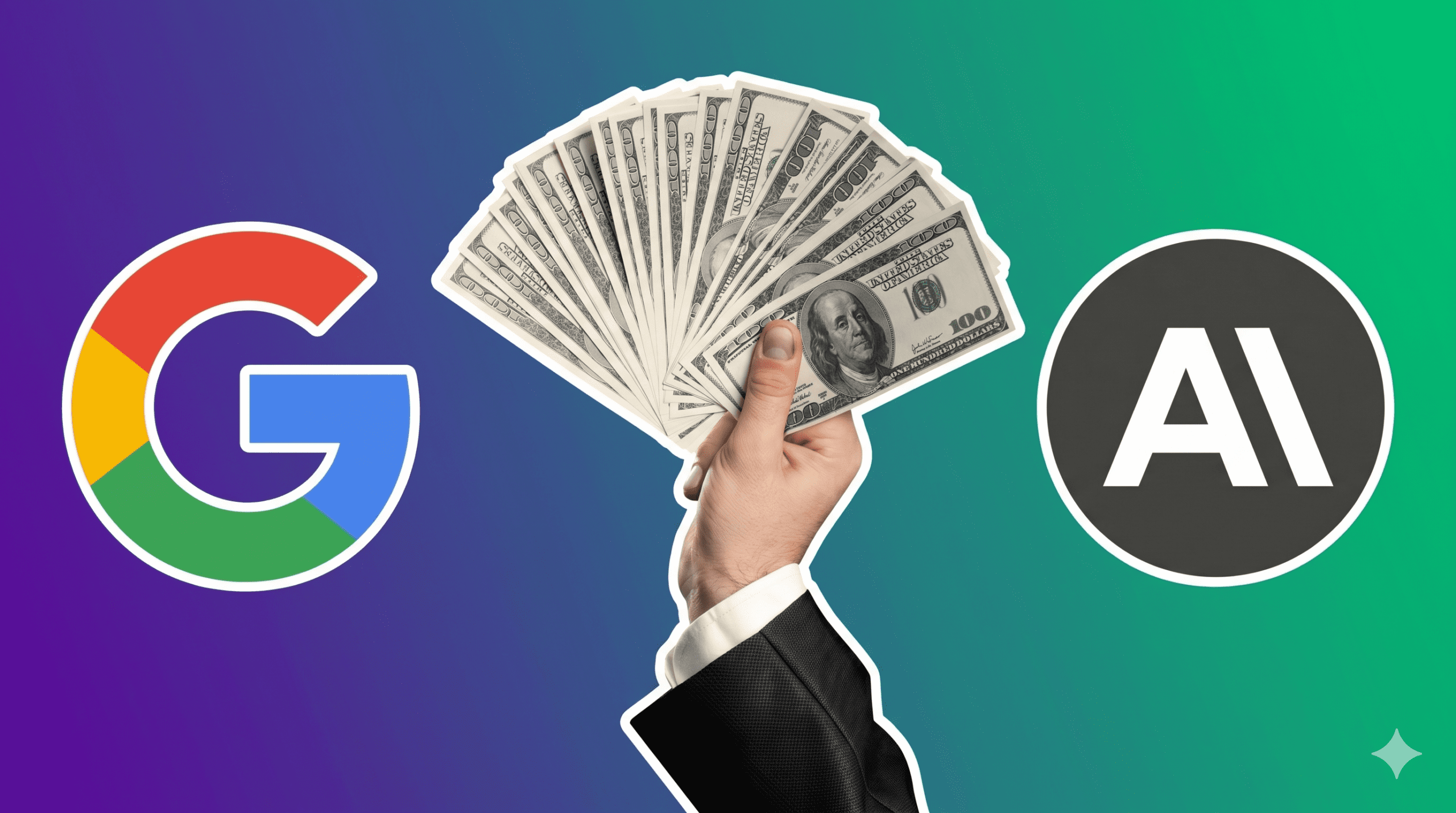
Google disclosed on April 24, 2026 that it will invest up to $40 billion in Anthropic, the AI lab behind the Claude model family. The structure is $10 billion immediate at a $350 billion post-money valuation, with another $30 billion tied to milestone-based performance targets. The deal also locks in 5 gigawatts of dedicated compute capacity on Google’s TPU infrastructure for Anthropic’s training and inference workloads. For a company that Google directly competes with through its own Gemini models, the size of this commitment represents the largest single investment in an AI lab outside Microsoft’s OpenAI partnership.
The context that makes this remarkable is Anthropic’s revenue trajectory. Annualized revenue has gone from $1 billion at the end of 2024, to $9 billion at the end of 2025, to roughly $30 billion as of early April 2026. That is the steepest revenue ramp in software history by a wide margin. The growth has been driven primarily by enterprise adoption of Claude Code, which has become the dominant AI coding tool inside large organizations, and by API usage from companies that have standardized on Claude for production workloads.
Google’s investment combines with Amazon’s concurrent $25 billion commitment to give Anthropic roughly $65 billion in pledged equity capital and 10 gigawatts of reserved AI training power across two hyperscaler ecosystems. Anthropic is reportedly considering an IPO as soon as October 2026 at a target valuation of $800 billion or more. If those numbers hold, Anthropic will be larger by market cap than most enterprise software companies in the S&P 500 within roughly 18 months of crossing $1 billion in ARR.
The strategic question is why Google would make a $40 billion bet on a direct competitor. Google has Gemini, which competes with Claude on capability. Google has TPUs, which compete with Nvidia for AI training silicon. Google has Cloud, which competes with AWS and Azure for AI workloads. By any conventional logic, Google should be using all three to take share from Anthropic, not funding it. The answer reveals where Google’s strategy has shifted: rather than betting that Gemini will be the dominant enterprise model, Google is hedging by ensuring it captures economics from both Gemini’s success and Anthropic’s success. The TPU compute commitment in particular means that even when enterprises choose Claude, Google profits.
For Anthropic, the deal is harder to read as a clean win. The dilution from $40 billion in incoming capital is significant even at a $350 billion valuation, and the dependency on Google’s TPU infrastructure deepens an already complex relationship with one of its primary competitors. But the alternative, growing into the next phase of the company without Google’s compute commitment, was likely worse. Anthropic’s compute needs at $30 billion ARR are enormous, and few entities outside the major hyperscalers can supply that capacity at scale.

The broader implication for the AI industry is that the era of independent AI labs may be ending. OpenAI is effectively a Microsoft subsidiary at this point through the AWS Pentagon deal and Microsoft’s existing equity. Anthropic is now structurally dependent on both Amazon and Google. The smaller frontier labs, including xAI, are tied to Musk’s broader corporate ecosystem. Independent AI development at frontier capability levels appears to require either being a hyperscaler or being financed by one. For LATAM and emerging markets, this concentration matters because access to frontier AI capabilities will increasingly be determined by which hyperscaler ecosystems are available locally and at what pricing.
The most interesting reading of Google’s bet is strategic patience. Rather than trying to beat Anthropic in the market, Google has bought permanent upside in whoever wins between Gemini and Claude. That kind of integrated portfolio bet, simultaneously running its own model, owning the infrastructure that runs competitors’ models, and holding equity in the leading competitor, is a strategy only a handful of companies on Earth can execute. For 2026, it positions Google as the only company guaranteed to win regardless of which model captures enterprise dominance.


