



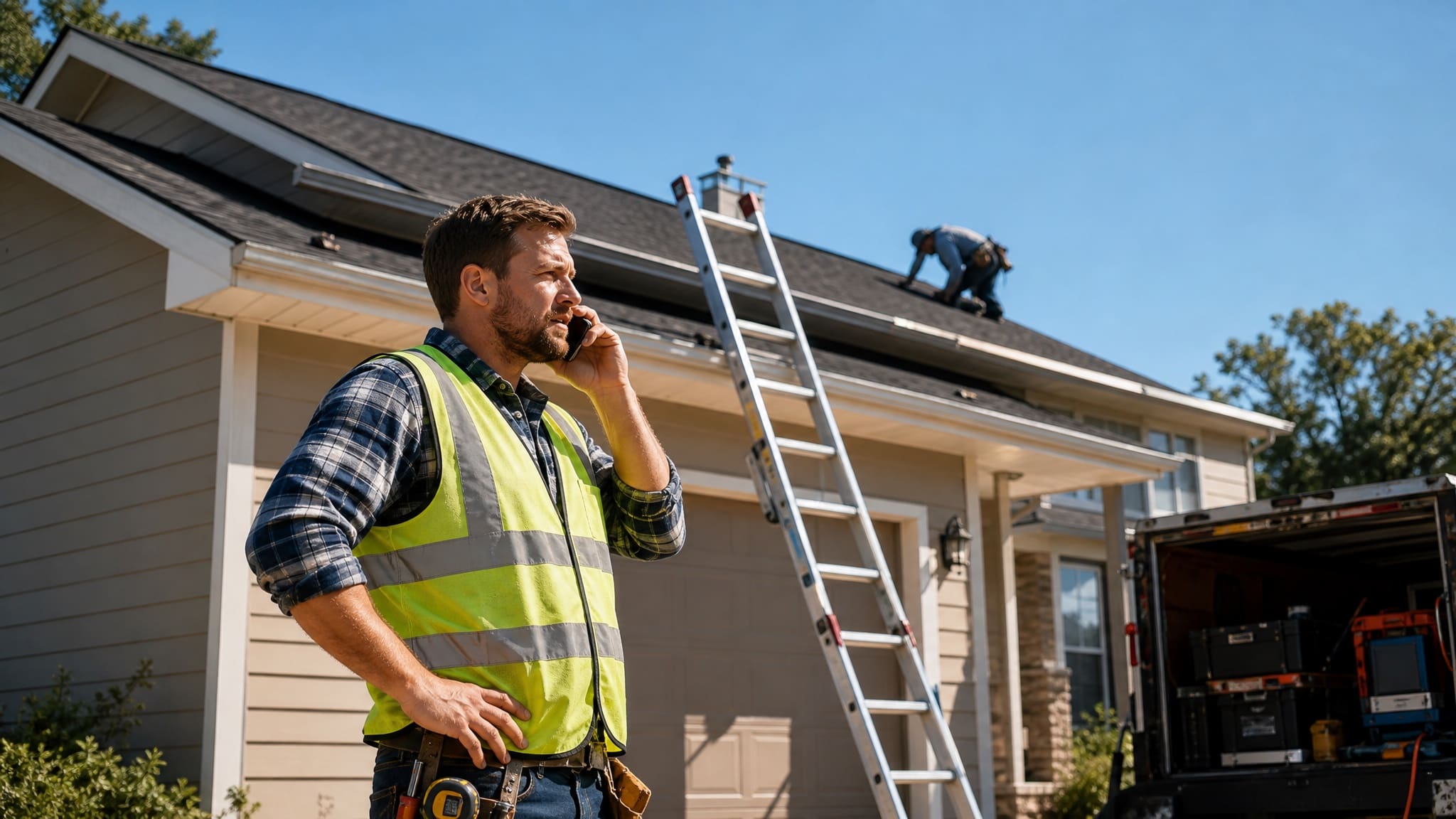
After a storm, a homeowner with a leak calls four roofers in twenty minutes. The one who books the inspection is almost never the one with the best reviews. It is the one who picked up. These call scripts for roofing companies cover every call that matters, from the panicked storm call to the estimate that went quiet three weeks ago.
Twenty scripts, ready to use. Fill in the brackets and put them by the phone.
Why the roofer who answers first wins the storm job
Roofing demand arrives in spikes. A hailstorm on Tuesday produces more inbound calls in two days than the previous month, and every roofer in the county is getting the same calls at the same time.
The constraint is not sales skill. It is that your crew is on a roof. Nobody on a pitch with a nail gun is answering the phone, and a homeowner with water coming through the ceiling does not leave a voicemail and wait. They dial the next number.
That is why good call scripts for roofing companies are built around speed and structure rather than persuasion. Qualify fast, book the inspection on the same call, and confirm in writing before you hang up. The persuasion happens at the inspection, not on the phone.
How to use these roofing call scripts
Three rules:
- Book the inspection on the first call. Not a callback, not a quote over the phone. An inspection date is the only real outcome of an inbound roofing call.
- Never diagnose a roof over the phone. You cannot see it, and a wrong guess costs you credibility at the inspection.
- Never tell a homeowner their claim will be approved. You can explain the process. Approval is the insurer’s decision, and promising it creates problems for everyone.
The structure behind every script here
Acknowledge the urgency, qualify in three questions, offer two inspection windows, confirm in writing. Four steps, under four minutes. Everything else belongs at the property.
Scripts for the inbound storm-damage call
These are the highest-stakes calls you take all year, and they arrive when you are least able to answer them. The first two sentences do all the work: acknowledge the urgency, check for actual danger, then move straight to scheduling. These call scripts for roofing companies deliberately skip the sales pitch, because a homeowner with water in the ceiling is not evaluating your company, they are trying to stop a problem.
1. The emergency leak call
I understand, water coming in is urgent. First, is anyone in danger or is there water near electrical? Then let me get you on the schedule. Where is the property?
2. The post-hail call
We have had a lot of calls from [neighborhood] after [storm date], so you are not imagining it. Let me ask three quick questions and then get an inspector out to you.
3. Triaging urgency honestly
From what you are describing, this sounds like [urgent / not immediately urgent]. Here is what I would do in the meantime: [temporary measure]. We can be there [timeframe].
4. When you cannot get there today
I am not going to promise you today and then not show up. The earliest we can be there properly is [date]. If it gets worse before then, call this number and we will reprioritize.
5. The temporary tarp conversation
We can put a temporary cover on it [timeframe] to stop the water while we schedule the full inspection. That is [price or “no charge with an inspection”], and it buys us time to do the real repair properly.
Scripts for qualifying roof age, material and access
Three questions decide whether an inspection is worth a truck roll. These call scripts for roofing companies get them asked without sounding like a form.
6. The three qualifying questions
Three quick things so I send the right person: roughly how old is the roof, do you know what material it is, and is it a single story or two? That is all I need.
7. Confirming property ownership and decision-making
And are you the homeowner, or is this a rental? I only ask because whoever signs off needs to be there for the inspection.
8. Checking whether they have already had someone out
Has anyone else looked at it yet? No problem either way, it just helps me know whether we are giving a second opinion or starting fresh.
9. Commercial or multi-unit property
For a [property type] we handle it a little differently. Can I ask the approximate square footage and whether there is a property manager I should coordinate with?
10. Politely declining a job outside your scope
Honestly, that is not the kind of work we do well, and I would rather tell you now than waste your time. For [specific issue] I would call [type of specialist].
Those five save more money than any sales technique, because the truck rolls you avoid cost the same as the ones that close.
Scripts for booking the inspection in the same call
An inbound roofing call has exactly one successful outcome: a date. Anything else, including a promise to call back with a price, is a lead you will probably lose to whoever booked theirs. These five scripts close the date without pressure.
11. Offering two windows
I can have someone there [option 1] or [option 2]. Which works better for you?
12. Explaining what the inspection involves
It takes about [duration]. We will get on the roof, photograph everything, and walk you through what we found before we leave. There is no charge and no obligation.
13. Confirming in writing before you hang up
I am sending you a text right now with the date, the window, and the name of the person coming. Can you confirm you got it?
14. When they want a price before booking
I can give you a range for [work type] in this area, but the honest answer is that the number depends on what we find. The inspection is free, and after it you will have a real figure rather than a guess.
15. When the homeowner is not ready to commit
That is fine. Can I at least get you on the schedule for an inspection so you have the information? If you decide to do nothing, that is a completely acceptable outcome.
Scripts for the insurance-claim conversation
This is where roofers get themselves into trouble, usually by trying to be reassuring. The safe and genuinely more persuasive position is the honest one: explain the process clearly, commit to documenting the damage properly, and be explicit that approval is the insurer’s decision and not yours.
16. Explaining how the process works
Here is how this usually goes: we document the damage, you file the claim, and the insurer sends an adjuster. We can be there when the adjuster comes so nothing gets missed. What we cannot do is tell you what they will approve.
17. When they ask if insurance will cover it
I cannot answer that, and anyone who promises you they can is not being straight with you. That is the insurer’s decision. What we can do is document everything properly so the claim is as strong as it can be.
18. Coordinating with the adjuster
When your adjuster schedules, let us know the date and we will have someone there. It helps a lot when both parties look at the same roof at the same time.
Scripts for the follow-up when they went quiet
Most roofing estimates are never followed up even once, which is why these two call scripts for roofing companies are worth more than they look. The second one in particular converts well precisely because it gives the homeowner an easy way out.
19. The 48-hour estimate follow-up
Hi [name], following up on the estimate from [date]. Any questions about what we found? If the number is the issue, tell me and I’ll see what we can adjust on scope.
20. The quiet lead, three weeks later
Hi [name], checking in on the roof at [address]. If you have gone another direction that is completely fine, just let me know so I stop bothering you. If you are still deciding, [material or pricing update] may be relevant.
How an AI voice agent covers the calls your crew misses on a roof
The scripts solve what to say. They do not solve who says it when every person you employ is on a pitch and the phone rings eleven times in an hour after a storm.
An AI voice agent covers exactly that window. It answers every call immediately, triages urgency, asks the three qualifying questions, books the inspection against your real calendar, and texts the confirmation. Emergencies get flagged to you instantly. Your crew stays on the roof and you come back to a full schedule rather than a voicemail box.
For the same structure applied to a neighboring trade, see our call scripts for HVAC companies and our AI receptionist scripts. To compare tools built for this, read about an AI answering service for roofers and the best AI voice agents for roofing contractors.
Frequently asked questions
Should I quote a roof over the phone?
No. Give a range if pressed, but make clear that the real number comes after an inspection. Phone quotes either lose you money or get revised upward later, and the revision is what damages trust.
What should never be said on a roofing call?
Never promise an insurance claim will be approved, never diagnose damage you have not seen, and never promise a same-day arrival you cannot make. All three feel helpful in the moment and all three cost you the job later.
How do these call scripts for roofing companies handle storm surges?
They are built for it. The qualifying questions are deliberately short so a high volume of calls can be triaged quickly, and the booking script offers two fixed windows rather than an open negotiation, which is what keeps the schedule from collapsing.
Can an AI answer storm calls without upsetting people?
Yes, provided it triages urgency properly and escalates genuine emergencies to a person straight away. What upsets a homeowner with water coming in is ringing out to voicemail, not a fast, competent automated answer that books them in.
How many follow-ups should I do on an estimate?
Two is usually right: one at 48 hours and one a few weeks later that explicitly gives them permission to say no. That second message gets a surprisingly high response rate because it removes the awkwardness.
Does this work for a small roofing crew?
It matters most for a small crew. When there are three of you and all three are on a roof, every call between eight and five goes unanswered, and in a storm week that is the entire season’s pipeline.
Having the right call scripts for roofing companies changes what happens during your busiest week: every caller gets qualified, every real job gets an inspection date, and nothing sits in a voicemail box while a competitor books it. And when nobody is free to pick up, let an AI voice agent run the same script.


