


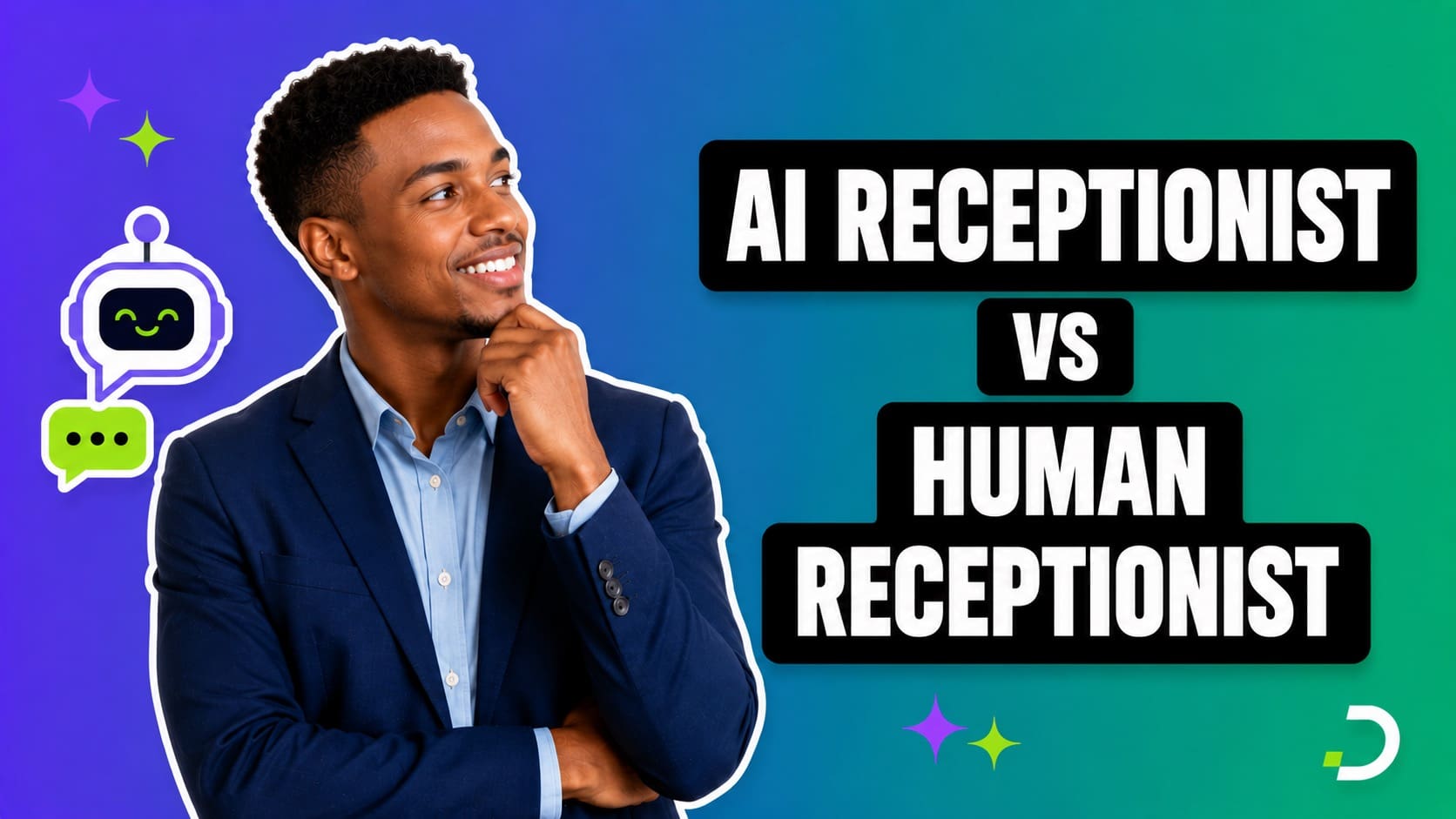
Picture your front desk on a busy Monday. The phone rings while your receptionist is already on another call, greeting a walk-in, and typing a message. One caller waits. Another hangs up. That second caller might have been your next big client. This is where the AI receptionist vs human receptionist question stops being theoretical and starts costing you money.
So which one actually wins in 2026? We put the two head to head on the things that matter: cost, availability, accuracy, scale, and languages. You will also see the cases where a human still comes out ahead, because that honesty matters when you are making a real decision.
Be quick, our free July strategy slots are almost gone.
★★★★★ 4.7 on Trustpilot
What is an AI receptionist?
An AI receptionist is a virtual voice agent that answers your calls, greets each caller, and handles the front desk work a human receptionist normally does. It books appointments, answers routine questions, captures caller details, and routes urgent calls to the right person. Unlike a human, it never sleeps, never takes a lunch break, and never puts a caller on hold to juggle a second line.
Think of it as your front desk, rebuilt in software. A human receptionist brings warmth and judgment. An AI receptionist brings speed, coverage, and scale. The rest of this guide shows exactly where each one wins.
Speed to lead: why a missed call is a lost sale
Here is the stat that reframes the whole debate. Harvard Business Review found that companies which respond to a new lead within an hour are far more likely to qualify it than those that wait even a little longer (HBR). In other words, speed wins deals.
A human receptionist cannot always answer on the first ring. They are on another call, at lunch, or gone for the night. An AI receptionist answers instantly, every time, at 2 p.m. or 2 a.m. So the lead that would have hit voicemail gets a real conversation instead. Because the first responder so often wins, that head start is hard to beat.
AI receptionist vs human receptionist: the side-by-side
Let us score them on the five factors that decide most front desk decisions. Here is the quick verdict, then the detail.
| Factor | Human receptionist | AI receptionist |
|---|---|---|
| Monthly cost | $2,900 to $3,900 loaded | $50 to $300 |
| Hours covered | About 40 a week | 24/7, all 168 hours |
| Calls at once | One | Unlimited |
| Sick days and turnover | Yes | None |
| Languages | One or two | Many, including Spanish |
| Time to launch | Weeks to hire and train | A few days |
The AI wins on cost, coverage, and scale by a wide margin. The human wins on warmth and physical presence. Now let us break down each row.
Cost
This is the biggest gap. A full time receptionist in the US earns a median wage of about $35,000 a year, according to the Bureau of Labor Statistics (BLS). Add payroll taxes and benefits, and the loaded cost climbs past $45,000. That is roughly $3,000 to $3,900 a month for 40 hours of coverage.
An AI receptionist runs from $50 to $300 a month for round the clock coverage. Even at the high end, you save more than 90 percent. For a small business, that gap alone often settles the debate.
Availability
A human receptionist covers business hours. An AI receptionist covers all of them. Nights, weekends, holidays, and the lunch hour are all live. Since many buyers call after hours, that coverage captures leads a 9 to 5 desk would miss entirely.
Scale
A human answers one call at a time. When three people call at once, two wait or hit voicemail. An AI receptionist answers every line at the same moment, so a sudden rush never sends a caller away. That matters most during ad campaigns, seasonal spikes, and the days after you go viral.
Accuracy and consistency
A human has good days and off days. An AI receptionist runs the same script every single call. It captures the same fields, asks the same qualifying questions, and never forgets to log a number. That consistency protects your lead data and gives every caller the same experience.
Languages
Most human receptionists speak one or two languages. An AI receptionist can greet callers in several, including natural Spanish with regional accents. For US businesses with bilingual customers, that captures calls a single language desk would lose.
When a human receptionist still wins
The AI does not win everything, and pretending otherwise would not help you. A human receptionist still leads in a few real situations.
- In-person hospitality. Someone has to greet walk-ins, offer coffee, and make a physical space feel welcoming. Software cannot hand a visitor a form or a smile.
- Complex emotional moments. A grieving family, a furious client, a delicate negotiation. These call for human empathy and judgment.
- Physical tasks. Signing for packages, managing keys, prepping a conference room. A receptionist does more than answer phones.
- High-touch VIP relationships. Some clients expect a familiar human voice who knows their history by heart.
For many businesses, the smart move is not either or. It is both. Let the AI receptionist handle the phones and after-hours coverage, and let your human staff focus on the in-person, high-value work only they can do.
The real cost comparison, month by month
Numbers make the choice concrete. Say a small business needs its phones answered every hour of every day. Here is what each path costs to get close to that.
| Human receptionist | AI receptionist | |
|---|---|---|
| To cover 40 hours a week | About $3,400 a month | $50 to $300 a month |
| To cover 24/7 | Three to four hires, $9,000 or more | Same $50 to $300 a month |
| Overtime and holidays | Extra pay | No change |
| Turnover and rehiring | Recurring cost | None |
To match true 24/7 coverage with humans, you need multiple shifts, which multiplies the cost. The AI receptionist covers the same hours at one flat rate. That is why the money argument gets one sided as your hours grow.
Get 2,000 Free Credits in Dapta
Make an account and put your AI receptionist to work today.
Which businesses switch to an AI receptionist first?
Some businesses feel the pain of missed calls more than others. These tend to move first:
- Home services and contractors. Plumbers, HVAC techs, and electricians work on a job site, not by the phone. Every missed call is a missed booking.
- Medical and dental offices. Front desks are slammed with in-person patients, so after-hours and overflow calls slip away.
- Law firms. A missed intake call often means the client simply dials the next firm on the list.
- Real estate. Buyers call about a listing now, not later, and agents are usually out showing homes.
- Salons and spas. Staff are with clients, so booking calls go unanswered during the busiest hours.
In short, if your team is often away from the desk, an AI receptionist pays for itself fast.
How to switch to an AI receptionist with Dapta
Switching is simpler than hiring. With Dapta, you build your AI receptionist with no code, so it is live in days instead of the weeks a new hire needs. You do not replace your team. You give them backup that never clocks out.
Here is what makes the Dapta AI receptionist stand out:
- Natural voice in English and Spanish, with regional accents your callers recognize, so it never sounds like a robot reading a menu.
- No-code setup, so you shape the greeting, questions, and routing without a developer.
- Real integrations, connecting to your CRM, calendar, and phone system, so leads and bookings land where your team already works.
- In-call actions, so the agent can book an appointment or take a payment during the conversation, not after.
Because pricing is usage based, your cost tracks your call volume, not a fixed salary. A quiet month costs less. A busy month scales without a single new hire. That is the core reason an AI receptionist beats a human team on cost as you grow.
So, which one wins?
For most small and growing businesses, the AI receptionist wins on the numbers. It covers every hour, answers every line, and costs a fraction of a salaried desk. For high-touch, in-person, or emotionally complex work, the human still wins. The strongest setup pairs them: AI on the phones and after hours, humans on the moments that need a heartbeat. You stop losing calls, and you stop overpaying to catch them.
Frequently asked questions
Does an AI receptionist sound robotic?
Not anymore. A modern AI receptionist uses natural sounding voices that pause, respond, and adapt like a person. Most callers cannot tell the difference on a routine call. You can also set the tone and greeting to match your brand.
Will it miss the nuance a human catches?
For routine calls, rarely. The AI captures details consistently and routes anything sensitive to a human. For a delicate or emotional conversation, it hands off to your team, so nuance is not lost, it is escalated.
Does it connect to my existing tools?
Yes. A good AI receptionist connects to your CRM, calendar, and phone system, so bookings and lead notes flow into the tools you already use. With Dapta, that setup takes no code.
Is my caller data secure?
It should be. Reputable providers encrypt call data and follow standard privacy practices. Ask any vendor how they store recordings and transcripts, and confirm it fits your industry rules before you commit.
How much does an AI receptionist cost?
Most plans run from $50 to $300 a month, far below a receptionist’s salary. Usage based pricing means you pay for the calls you handle, so the cost scales with your business instead of a fixed payroll line.
Can an AI receptionist book appointments?
Yes. It checks your live calendar, offers open slots, and books the appointment during the call. With Dapta, it can also reschedule and send confirmations, so your calendar stays full without manual back and forth.
What happens if the AI cannot answer a question?
It escalates. A well built AI receptionist recognizes when a question is outside its scope, then routes the caller to a human or takes a detailed message. So callers never get stuck in a loop.
Will it replace my receptionist?
Usually not. Most businesses use an AI receptionist to cover overflow, after hours, and repetitive calls, so their human staff focus on in-person and high-value work. It is backup and scale, not a pink slip.
For the full picture, explore our related guides:
- AI for Home Services: the complete playbook
- AI Answering Service: what it really costs
- AI Receptionist for Small Business
Ready to answer every call without growing your payroll? Start free today and put your AI receptionist to work in minutes.