



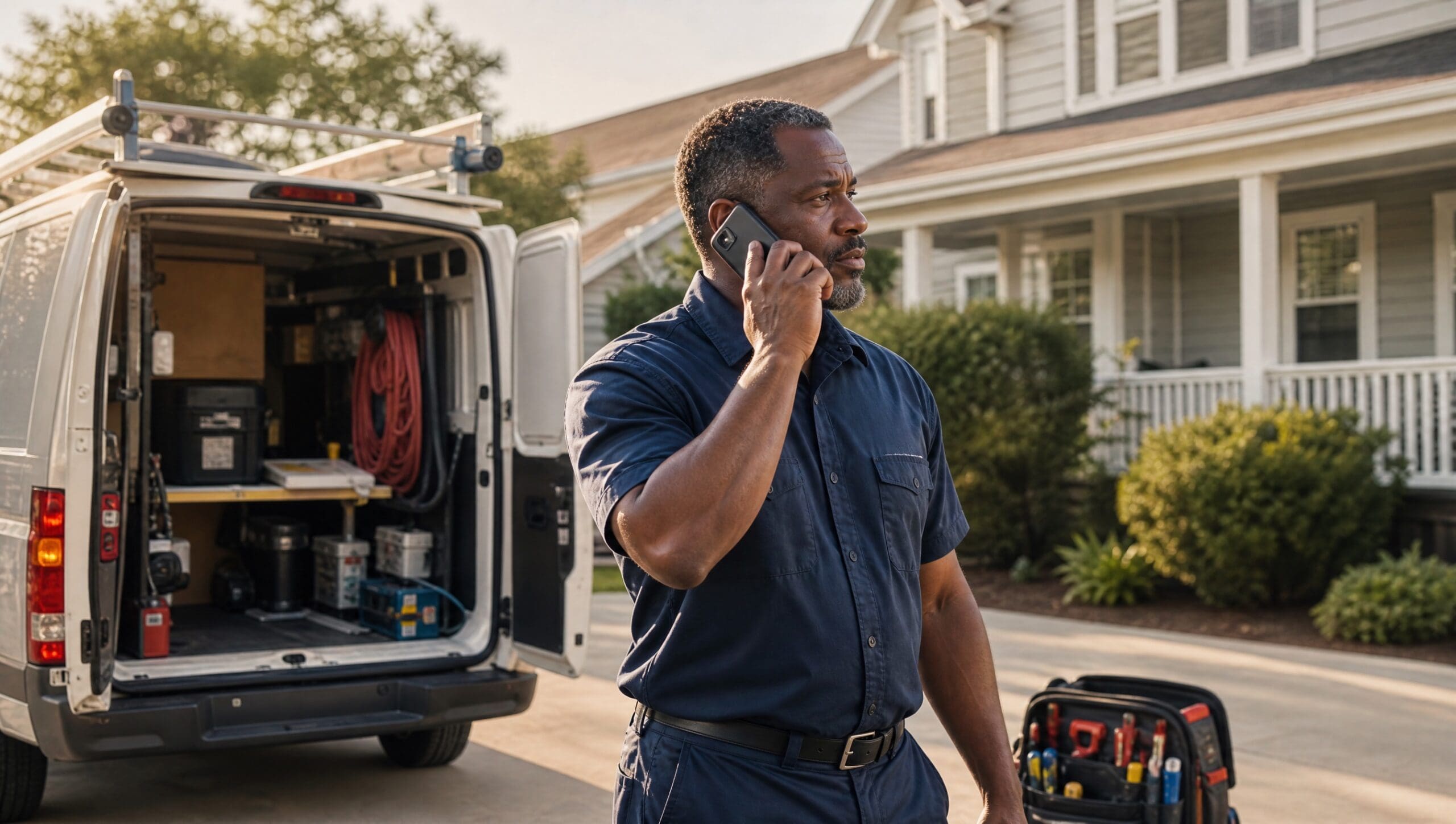
The call that comes in at 7:40 on a Tuesday evening is worth more than the one at 10 in the morning. The evening caller has a problem right now, has probably already tried a competitor, and is ready to book with whoever picks up.
Most businesses send that caller to voicemail. The ones that do not usually win the job by default.
Below are 20 answering service scripts built for the hours when nobody is at the desk. They cover the emergency triage, the price shopper, the caller who just wants to book tomorrow, and the one who needs a human tonight. Copy the block you need and replace the bracketed fields.
After-hours calls behave differently
If you reuse your daytime script after 6pm, it will underperform. Three things change once the office closes.
Urgency is higher. A larger share of evening and weekend callers have an active problem. Water is coming through a ceiling, a car will not start, a tooth is throbbing. They are not researching.
Patience is lower. Callers know they are calling outside hours. They will give you about fifteen seconds to prove someone can help before they dial the next listing.
Expectations are different. Nobody expects a full crew at 9pm. They do expect a clear answer about what happens next and when. Vagueness is what loses them, not the wait.
Good answering service scripts lean into that. They confirm fast, triage honestly, and commit to a specific time.
The structure every after-hours script needs
Four beats, in this order. Skip one and the call gets longer and converts worse.
Identify and reassure. Name the business and confirm they have reached the right place. One sentence.
Triage. Emergency or not. This single question decides everything downstream, so ask it before anything else.
Capture the minimum. Name, callback number, address or service area, and one line about the problem. Nothing more.
Commit to a next step. A booked slot, a dispatch, or a callback with a named time. Never end open.
20 answering service scripts for after-hours calls
These are written for speech. Keep every turn short, because long sentences sound wrong when spoken and callers talk over them.
Opening the call (1 to 4)
1. “Thanks for calling [BUSINESS]. Our office is closed, but I can help you right now. Is this an emergency?”
2. “You’ve reached [BUSINESS] after hours. I can book you in or get someone out tonight. Which do you need?”
3. “[BUSINESS], good evening. Tell me what’s going on and I’ll figure out the fastest way to help.”
4. “Thanks for calling [BUSINESS]. Before anything else, can I get a number to reach you in case we get cut off?”
Emergency triage (5 to 8)
Define your emergency criteria in advance and put them in the script. Do not leave it to judgment at 11pm.
5. “Is there [ACTIVE WATER, NO HEAT, SMOKE, INJURY] right now? That changes how fast we move.”
6. “That counts as an emergency. I’m paging [ON-CALL TECH] now. Stay on the line while I confirm they’ve got it.”
7. “That sounds urgent but not dangerous. I can get someone to you first thing at [TIME]. In the meantime, [SAFE INTERIM ACTION].”
8. “Before anything else, if anyone is in danger, hang up and call [EMERGENCY NUMBER]. If not, I’ll get you handled tonight.”
Booking for the next day (9 to 12)
Most after-hours calls should end in a booked slot, not a callback.
9. “I can get you on the schedule for tomorrow. I have [TIME] or [TIME]. Which is better?”
10. “You’re booked for [DAY] at [TIME]. I’ll text confirmation to [NUMBER] in the next minute.”
11. “Tomorrow is full, but I have [DAY] at [TIME]. Want me to hold it, or should I put you on the cancellation list too?”
12. “I’ll book you now and [TEAM] will call between [WINDOW] to confirm the exact arrival time.”
The price shopper (13 to 15)
Evening price shoppers are calling three companies. The one that gives a straight answer usually gets the visit.
13. “Most [SERVICE] calls run between [LOW] and [HIGH]. The difference is usually [FACTOR]. Do you know which you’ve got?”
14. “After-hours calls carry a [FEE] callout. If it can wait until morning, you avoid that. Which would you prefer?”
15. “I can’t quote exactly without seeing it, but I can get someone there [DAY] at [TIME] to give you a firm number. Should I book it?”
Taking a message that is actually useful (16 to 18)
16. “I’ve got [NAME], [NUMBER], [ADDRESS], and that it’s about [ISSUE]. Anything else they should know before they call you?”
17. “[TEAM] will call you back before [SPECIFIC TIME]. If you haven’t heard by then, call us and reference [TICKET].”
18. “Is [NUMBER] the best number in the morning, or is there a better one?”
Closing the call (19 and 20)
19. “So that’s [SUMMARY OF NEXT STEP] at [TIME]. You’ll get a text in a minute. Anything else while I have you?”
20. “You’re all set, [NAME]. If anything gets worse tonight, call this same number and I’ll page the on-call tech.”
How to adapt these answering service scripts to your trade
The frame holds. The triage question changes completely.
Plumbing and HVAC. Triage on active water, no heat in freezing conditions, and gas smell. Everything else waits until morning without argument.
Electrical. Triage on burning smell, sparking and total outage. Add a safety instruction before any booking question.
Dental and medical. Triage on bleeding, swelling and trauma, then route to the on-call clinician. Your script must never offer clinical guidance.
Legal. Capture matter type and any deadline. Anything involving an arrest or a filing date tomorrow goes to a person immediately.
Restaurants and retail. There is rarely a true emergency. Use the after-hours slot for reservations, large orders and next-day callbacks.
Whatever the trade, write your emergency criteria as a list before you write the answering service scripts themselves. The list is the hard part. The wording is easy once the list exists.
If an AI agent answers your after-hours line, the list and the wording both go into its instructions. Our guide on how to write an AI voice agent prompt shows how to turn them into a prompt the agent follows.
Mistakes that cost you the after-hours call
- Opening with an apology. “Sorry, we’re closed” tells the caller to hang up. Lead with what you can do.
- Reading business hours. They already know. Say when you can help instead.
- Asking for the full intake. Five fields, then book. Everything else can happen tomorrow.
- Promising a callback with no time. “Someone will get back to you” is how callers end up at a competitor. Name a time.
- Treating every call as urgent. If everything pages the on-call tech, the on-call tech stops answering.
- Having no path to a human. A caller who asks twice for a person should get one, or at least a firm callback commitment.
What to measure after you go live
Four numbers tell you if the scripts are earning their keep.
After-hours booking rate. Track it separately from daytime. Blending them hides the entire result.
Emergency dispatch accuracy. Of the calls that paged someone, how many were genuinely emergencies. If it is under about eight in ten, your triage question is too loose.
Callback conversion. Of the messages taken, how many turned into booked work. A low number usually means the message lacked a committed time.
Abandon rate before answer. If callers drop in the first few seconds, the problem is answer speed or the opening line, not the script body.
Change one script at a time and give each version at least a few dozen calls before judging it.
Building your escalation rules before you go live
The answering service scripts above assume one thing is already decided: who gets woken up, and for what. Settle that first, in writing.
Always page the on-call. Active water damage, no heat below freezing, gas smell, sparking or burning, and anything with an injury. These are observable facts, not judgment calls, which is exactly why they belong on the list.
Never page anyone. Routine bookings, reschedules, quotes, hours and directions, and follow ups on existing jobs. If these reach a person at midnight, the setup is costing you more than voicemail did.
Page in the morning, with context. Complaints about completed work, billing disputes, and anything a caller has already phoned about twice. These need a person, but not at 2am.
Two details make escalation work in practice. First, tell the caller what is happening, because “I’m paging the on-call tech now, stay with me” holds people who would otherwise hang up. Second, pass the details along, so the technician calls back knowing the address and the problem instead of starting over.
Recording and voice settings that make scripts land
Even well written answering service scripts fail if the delivery is wrong. Three settings matter more than the wording.
Pace. Slightly slower than normal reading speed. Your evening caller may be holding a flashlight, standing in a puddle, or driving.
Interruption handling. The moment the caller speaks, the system stops. Nothing loses an urgent caller faster than being talked over.
Silence tolerance. Wait about two seconds before prompting again. Callers describing a problem pause to think, and cutting in makes them lose the thread.
One more that gets missed: keep the same voice across the whole call. If a handoff changes voice mid conversation, callers assume they were transferred and start explaining from the beginning.
Frequently asked questions
Do I need different answering service scripts for nights and weekends?
Usually yes, but the difference is smaller than people expect. Weekends carry more non-urgent booking calls and fewer true emergencies. Keep the same triage question, and swap the booking offer to reflect Monday availability rather than tomorrow.
Should an after-hours script quote prices?
Give a range and name what moves it. Refusing to answer sends price shoppers to the next listing, and a range plus a booked visit converts better than either silence or a hard number you may not honor.
How do I stop everything from being flagged as an emergency?
Write explicit criteria and put them in the script as a yes or no question about observable facts. “Is there water coming in right now” works. “Is this urgent” does not, because every caller says yes.
Can AI handle after-hours calls on its own?
For triage, booking and message taking, yes, and that covers the large majority of after-hours volume. Keep a clear escalation path for genuine emergencies, angry callers and anything regulated. The goal is not zero human involvement, it is that nobody wakes up for a call that could have been booked.
What is the single highest value script here?
Number 9, the booking offer with two specific times. Most after-hours calls die because the script takes a message instead of booking. Offering two slots turns a message into an appointment on the same call.
After-hours calls are the cheapest new revenue most service businesses have, because the caller already chose to call you. Start with the opening line and the two slot booking offer, since those two change the number fastest, then build your triage list around the calls you actually get.
For more on setting this up, see our guides to the 6 best AI receptionists for small business, AI answering services for cleaning companies and 25 AI receptionist scripts that book more appointments.


